Choosing a lot in The Villages at Shawnee Bend can feel simple at first glance. You see water, views, trees, and space, and it is easy to assume the best parcel is just the one with the prettiest setting. In reality, the smartest choice usually comes down to how the lot is officially classified, what that classification allows, and how the site will work with your plans. If you want to build with confidence in Camden County, this guide will help you understand the lot options and the details that matter most. Let’s dive in.
Why lot classification matters
In The Villages at Shawnee Bend, lot type is more than a label on a listing sheet. The recorded classification affects minimum home size, setbacks, review requirements, and in some cases whether you can have waterfront features like a dock or seawall.
The property owners association guidelines say classifications appear on the sales plats, and the Review Committee confirms the correct designation if there is any question. That means your due diligence should start with the recorded lot class, not just the view from the road or the map image in marketing materials.
The main lot types explained
The covenants identify several lot classes, but most buyers will focus on five key categories: Waterfront Estate, Waterfront, Interior Estate, Interior, and Limited Waterfront. Each one offers a different mix of shoreline rights, home size requirements, privacy, and cost.
Waterfront Estate lots
Waterfront Estate, or WE, lots have a minimum home size of 2,200 square feet. These lots have the broadest waterfront build standards in the covenants, and the rear setback is measured from the 662-foot contour line.
If you want a custom lakefront home with the strongest waterfront positioning in the neighborhood, this is usually the top tier. These lots are often the best fit for buyers who prioritize shoreline control, expansive lake presence, and long-term custom-home value.
Waterfront lots
Waterfront, or WF, lots have a minimum home size of 1,800 square feet. The covenants give WF lots waterfront privileges such as docks and seawalls, though you still have to comply with the architectural review process and shoreline permitting requirements.
For many buyers, WF lots offer the classic Lake of the Ozarks experience. You get direct waterfront benefits without necessarily stepping into the larger home minimum required on some estate lots.
Interior Estate lots
Interior Estate, or IE, lots require a minimum home size of 2,000 square feet. These are the larger inland estate lots and are often the closest thing to a luxury inland alternative to true lakefront.
If you want extra room, privacy, and a custom-home feel without paying for direct shoreline rights, an IE lot may be a strong option. This class can appeal to buyers who value space and a more private setting.
Interior lots
Interior, or I, lots have a minimum home size of 1,600 square feet. These are the most straightforward inland build lots in the community.
For buyers who want to enter the neighborhood at a lower land cost or keep the build simpler, Interior lots can make sense. They trade direct water access for flexibility and typically a more approachable starting point.
Limited Waterfront lots
Limited Waterfront, or LWF, lots require a minimum home size of 1,800 square feet. The important distinction is that no docks are allowed on these lots.
This is one of the easiest classifications for buyers to misunderstand. A lot may sit near the water or feel waterfront in person, but if it is classified as LWF, it does not carry the same dock rights as WF or WE.
How buyers usually compare value
In practical terms, lot value in The Villages at Shawnee Bend often follows a clear pattern. Shoreline control comes first, then view, then lot size and privacy.
That makes sense based on the recorded classifications and the current community marketing. WF and WE lots offer the rarest combination of shoreline benefits, lake access potential, and custom-home positioning. Lake-view and interior options can offer lower upfront cost, simpler builds, or more usable yard space, depending on the parcel.
The developer currently markets waterfront lots with sunrise, sunset, and main-channel views. It also markets lake-view lots as offering seasonal or year-round lake views with spacious yards, while large interior lots are described as offering privacy and often more than an acre of green space.
Current advertised ranges can also help frame expectations, though pricing and availability can change. Waterfront lots have been marketed from about $150,000 to $1,800,000, lake-view lots from about $50,000 to $165,000, and large interior lots from about $40,000 to $75,000.
Buildability is about more than price
A lower-priced lot is not always the lower-cost project. In this community, buildability can depend on topography, contour lines, driveway design, drainage, utility connections, and shoreline restrictions.
The POA guidelines require all construction to stay within the applicable setbacks. That affects where your house, deck, driveway, and any waterfront improvements can go, so the recorded class directly shapes the design process.
Waterfront topography can change your plans
On waterfront parcels, slope and contour matter a lot. The guidelines require a sealed elevation survey, contour lines in two-foot increments, and specific contour references for waterfront properties.
The same guidelines say existing grade generally should not be altered outside approved construction areas. They also note that narrow, shallow, or bluff-like waterfront lots may qualify for special review, which can affect what is practical to build.
Driveway and drainage matter early
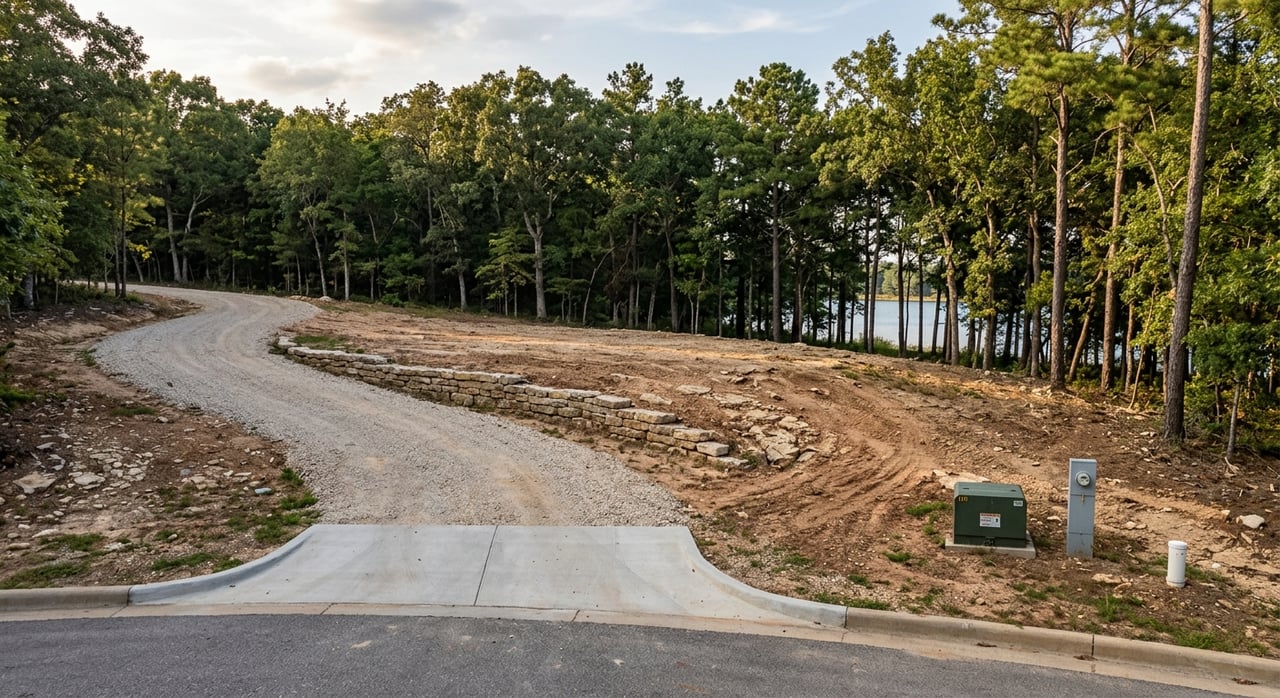
The official community site says access comes from Business Route 54 by way of the community bridge and Villages Way. Once you get to the lot level, the guidelines require hard-surface driveways, documentation of driveway location and grades, and culverts where drainage ditches exist.
That means entry layout, grading, and stormwater handling can affect both design and budget. A lot that looks easy from the street may still need more site work than expected.
Utilities to verify before you buy
The community is marketed with paved roads, underground utilities, fiberoptic internet, and central water and sewer lines. Those are important advantages, especially for custom-home buyers who want modern infrastructure already in place.
Still, you should verify current service details rather than rely on older references alone. The older POA guidelines name Four Seasons Lakesites Water and Sewer Company and describe a pressurized sewer system that requires a grinder pump and sump pit, while Camden County PWSD#4 says its service area includes the entire Villages of Shawnee Bend and that it purchased Lake Region Water and Sewer Company in 2017.
The practical takeaway is simple: confirm current hookup requirements and responsibilities with Camden County PWSD#4 before closing or finalizing plans. The guidelines also identify Co-Mo Electric Cooperative for electric service and note communication coordination during driveway work.
Dock rights and shoreline rules
If lake access is a major goal, never assume a lot can have a dock just because it touches or overlooks the water. In this neighborhood, only WF and WE lots receive waterfront privileges such as docks and seawalls under the POA guidelines, while LWF lots do not.
Shoreline work at Lake of the Ozarks is also regulated beyond the neighborhood rules. Ameren says all docks require a permit, and permit approval is required before work affecting project lands. Ameren also says Corps approval is required for certain activities lakeward of elevation 658.5 feet or in wetlands.
Ameren’s shoreline plan says most lakefront owners own to the 662-foot contour, which should be confirmed before making vegetation changes. For buyers, that means shoreline rights, dock potential, and vegetation work all need to be verified carefully before you commit.
Architectural review is part of the process
One appealing feature of The Villages at Shawnee Bend is that you can choose your own architect and builder, subject to architectural review. That gives you flexibility, but it also means lot choice and home design are closely connected.
A floor plan that works well on one lot may not fit another because of setbacks, slope, driveway geometry, or minimum square footage rules. Before you get attached to a specific design, review the lot classification and the POA process so your plan matches the parcel.
A smart due diligence checklist
If you are comparing lots in The Villages at Shawnee Bend, keep this checklist handy:
- Confirm the recorded lot classification on the sales plat before writing an offer.
- Verify minimum home size requirements for that specific class.
- Confirm whether the lot is WF, WE, or LWF before assuming dock potential.
- Order a current survey showing property lines, easements, contour elevations, driveway location, and finish grades.
- Check current water and sewer hookup requirements with Camden County PWSD#4.
- Review driveway access, culvert needs, drainage, grading limits, and tree-removal restrictions early.
- Study the architectural review process before selecting final building plans.
- Remember that the developer’s map warns not every parcel shown is necessarily subject to the covenants.
What this means for your decision
The best lot for you depends on your real goals. If you want maximum lakefront rights, focus first on WF and WE lots and confirm shoreline details early. If you want a custom home with more privacy and less shoreline complexity, IE or I lots may offer a better fit.
If you are trying to balance budget and lake feel, pay close attention to view lots and LWF parcels. They can offer a strong setting, but they should be evaluated carefully so you understand exactly what you are gaining and what you are giving up.
At The Villages at Shawnee Bend, lot value is driven less by acreage alone and more by recorded classification, shoreline rights, contour and elevation issues, and utility or access complexity. When you understand those moving parts up front, you can buy with a lot more clarity.
If you are weighing lot options in The Villages at Shawnee Bend or anywhere around Lake of the Ozarks, Ebbie Bogema can help you compare properties, spot important red flags, and move forward with confidence.
FAQs
What does Limited Waterfront mean in The Villages at Shawnee Bend?
- Limited Waterfront, or LWF, means the lot has a 1,800 square foot minimum home size but does not allow docks.
What lot types allow docks in The Villages at Shawnee Bend?
- According to the POA guidelines, Waterfront Estate (WE) and Waterfront (WF) lots receive waterfront privileges such as docks and seawalls, subject to review and permitting.
What are the minimum home sizes by lot type in The Villages at Shawnee Bend?
- WE requires 2,200 square feet, IE requires 2,000, WF requires 1,800, LWF requires 1,800, and Interior requires 1,600.
Why is lot classification important when buying land in Camden County, MO?
- In this community, the recorded lot classification affects setbacks, minimum home size, waterfront privileges, and how your home and site improvements can be designed.
What utilities serve The Villages at Shawnee Bend?
- The community is marketed with central water and sewer lines, underground utilities, and fiberoptic internet, and Camden County PWSD#4 says its service area includes the entire Villages of Shawnee Bend.
What should you verify before buying a waterfront lot in The Villages at Shawnee Bend?
- You should confirm the recorded lot class, dock rights, shoreline permitting needs, survey details, contour and elevation conditions, driveway access, and current utility hookup requirements.